Check a credential for risk#
Every decode runs an automatic audit, so you see what a reviewer would object to, graded from critical down to info.
A credential can decode cleanly and still be dangerous. The Security Audit tab answers the question a decode leaves open: given what this credential says about itself, what would a reviewer object to?
Every protocol has its own audit, and it runs automatically whenever you decode something. There is no button to press.
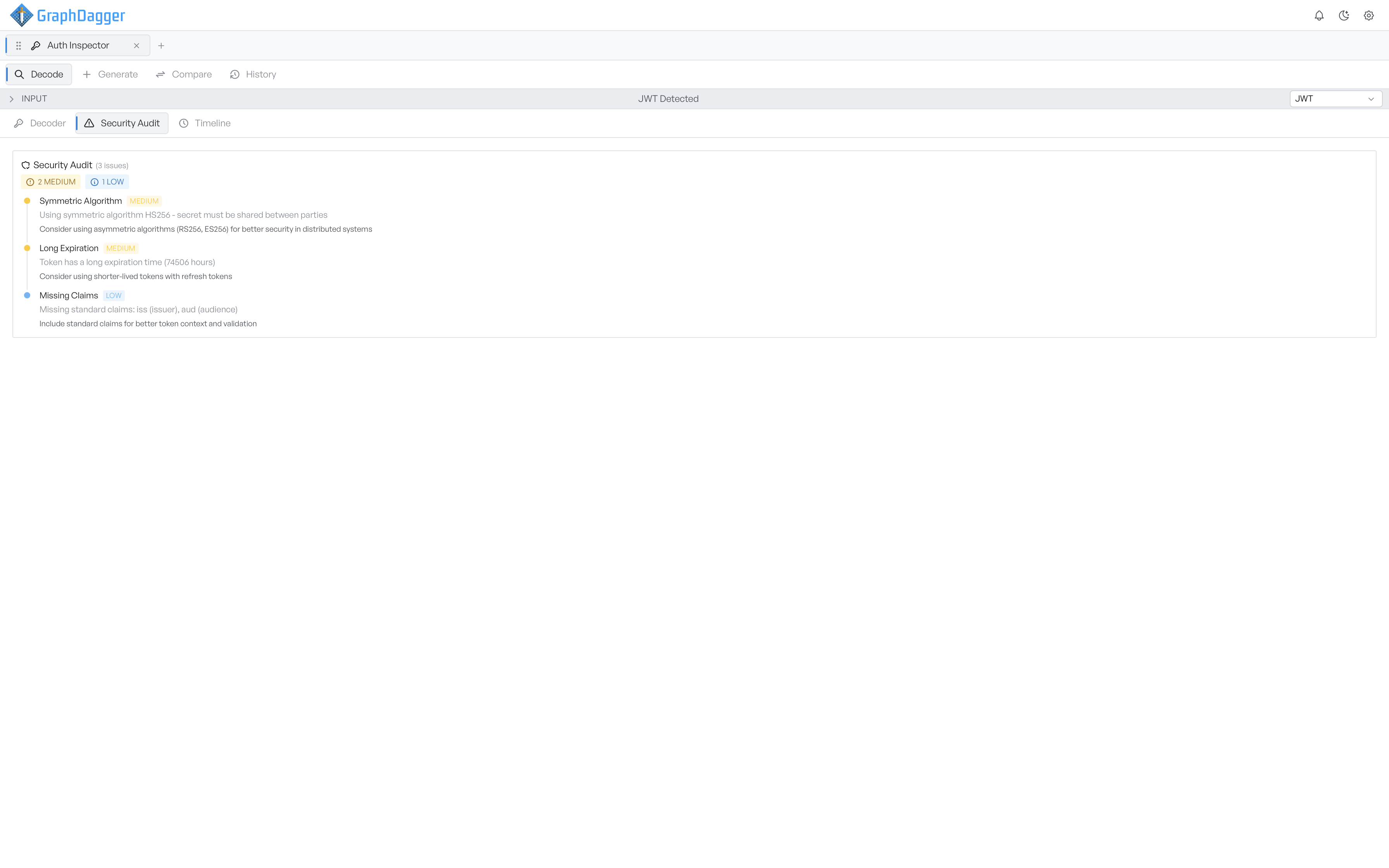
The five severity bands#
The header counts the issues and breaks them down by severity. Each finding gives you a title, the severity, a description of what is wrong, and a recommendation for what to do about it.
Severity runs across five bands.
| Severity | What it means |
|---|---|
| Critical | The credential cannot be trusted as it stands. Signature bypass, expiry, or plaintext transport. |
| High | A serious weakness a reviewer would block on, such as a missing expiry or a broken algorithm. |
| Medium | A real weakness that is not a direct bypass, such as a symmetric algorithm or a missing audience restriction. |
| Low | Hygiene. A missing standard field, or a detail that will cause trouble later. |
| Info | Context rather than a problem, including the summary line describing what was found. |
When nothing is wrong, the panel says so instead of showing an empty list.
What each protocol is checked for#
The checks follow the ways each protocol breaks in practice.
JWT covers the classics.
algofnone: critical.- Missing
expclaim: high. - Symmetric signing algorithm: medium.
- Lifetime over 24 hours: medium.
- Missing standard claims: low.
- Expiry and clock-skew observations: info.
An alg of none is critical because a verifier can skip signature validation entirely. A symmetric algorithm is medium because you have to share the secret with everyone who verifies the token.
SAML is mostly about whether the assertion can be forged or replayed.
- Unsigned assertion: critical.
- Expired assertion: high.
- Missing audience restriction: high.
- SHA-1 signature: medium.
- Missing conditions element: medium.
- Missing issuer, name identifier, authentication context, or session index: low.
OAuth checks the shape of an authorisation request.
- HTTP instead of HTTPS on the endpoint: critical.
- Implicit flow: high.
- Missing PKCE challenge: medium.
- A plain rather than S256 challenge method: medium.
- Missing state parameter: medium.
These checks apply to authorisation URLs. Tokens, discovery documents, and JWKS sets decode without an audit.
X.509 checks the certificate's validity, its algorithms, and its key.
- Expired certificate: critical.
- Not-yet-valid certificate: critical.
- SHA-1 or MD5 signature: high.
- RSA key under 2048 bits: high.
- Self-signed certificate: medium.
- Missing subject alternative name: medium.
- Validity period over 397 days: medium.
- Missing revocation endpoint: low.
Kerberos is about encryption strength.
- RC4 ticket encryption: critical.
- DES ticket encryption: high.
RC4 is critical because it makes Kerberoasting practical.
Findings in Compare and History#
The audit is not confined to this tab. Compare runs the same checks on both sides and shows the counts above each column, so you see whether a credential got safer or riskier between two versions. History puts the worst finding on each entry as a chip, so a list of past credentials doubles as a list of problems.