Actions and Logic blocks#
Send data down one branch or another, catch malformed input where it enters, pace a chain with a wait, and run a saved flow as a single block.
Most blocks in the catalogue transform data. These ones decide what happens next: whether a branch runs at all, which of several paths the data takes, and when one flow should hand off to another. They carry no transform of their own. That is what makes them the joints of a larger pipeline.
Flow#
The only block in the Actions category. It runs another saved transform inside this one and hands back what it produced.
Its Run input starts the sub-flow, and its Output carries the result. Its Done output fires when the sub-flow finishes, so you can sequence work that must happen afterwards. It also grows an input for each entry point the referenced flow expects.
Use it to break a large canvas into flows you can test on their own, then compose them. A decoder you have already saved and proved is more trustworthy as a single block than as thirty blocks inside a bigger flow.
Evaluate#
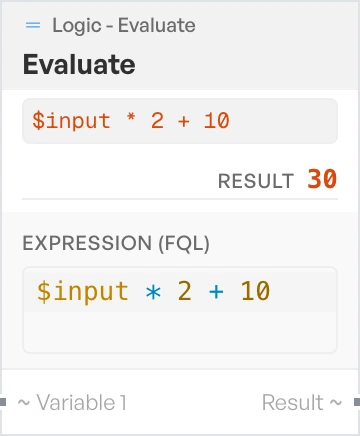
Works out an expression and emits the answer on Result. It grows one input per variable your expression refers to, starting at Variable 1.
Reach for it when you need a small piece of arithmetic or string shaping that does not deserve a block of its own.
Condition#
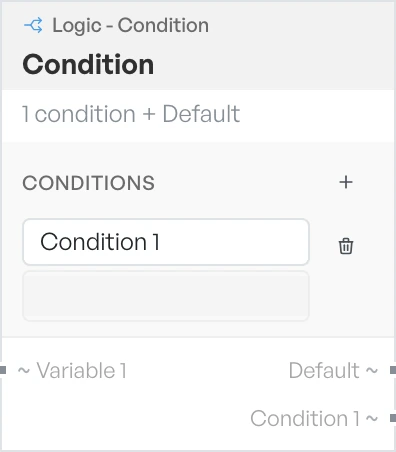
Multi-way branching, first match wins. Each case you add becomes its own output, and the data leaves through the first case that matches. Data that matches nothing leaves through Default.
Use it to route by shape or content: send hashes one way, addresses another, everything else to Default.
If#
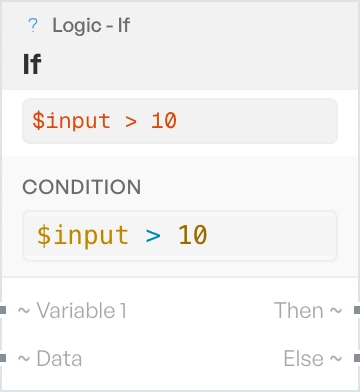
Two-way branching. It tests Variable 1. It then sends whatever arrived on Data out through Then or Else.
Simpler than Condition when there are only two outcomes.
Validate#
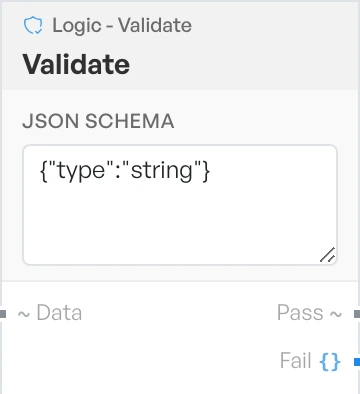
Checks incoming data against a schema. Data that matches leaves through Pass; data that does not leaves through Fail, carrying an object describing what was wrong.
Put it at the boundary of a flow that consumes something you did not produce. It then catches malformed input where the input enters, not three blocks later.
OR#
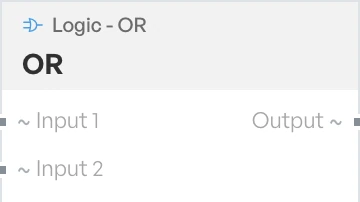
Forwards whichever input arrives first. Its usual job is to join the Then and Else outputs of an If back together, when both branches continue into the same downstream chain.
Delay#
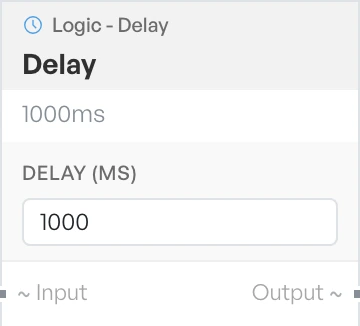
Passes its input through unchanged after a wait you set in milliseconds. Use it to pace requests against a service that objects to bursts.
Independent branches run at the same time, so a Delay holds up only the chain it sits in. It cannot order two branches that are not connected. Connect them instead.